TV Over Fireplace Mounting: What to Sort Out Before You Drill
July 24, 2026
QUICK ANSWER: TV over fireplace mounting works, but three things decide whether the screen lasts: heat, viewing height, and the wall behind it. A gas fireplace pushes roughly 20,000 to 35,000 BTUs of warm air up the wall each hour, and most TVs are rated to run only up to about 100 to 104 degrees Fahrenheit, so that heat has to be blocked or sent somewhere else. A tilting or full-motion mount fights the high viewing angle a mantel forces on you, and the screen should sit far enough above the firebox to stay out of the hottest air. Brick and stone walls also need the right anchors and a wiring path mapped before anyone picks up a drill.
You bought a 65-inch TV, and the only wall it fits is the one over the fireplace. Your couch already faces that direction, the outlets are close, and the room more or less designs itself around that spot. It's the natural place for a screen. It's also the one spot in the house where a TV faces the most working against it, and most people don't find that out until the picture starts acting strange a year in.
The good news is that none of the problems are mysteries. Heat, angle, wiring, and the mount itself each have a fix. You just have to handle them before the screen goes up, not after. Sort them out early and the fireplace wall becomes the cleanest spot in the room. Skip a step and you're fishing a warm, glitchy TV off the mantel next winter.
Heat is the first thing to settle
Warm air rises. That sounds obvious until you remember your TV is sitting directly in its path. The flame itself isn't the enemy here. The problem is convective heat, the stream of warm air that climbs the wall above the firebox every minute the fire runs.
A typical gas fireplace throws off somewhere between 20,000 and 35,000 BTUs an hour, and a good share of that goes straight up. Over a season it bakes the wall right above the mantel. Most TV makers rate their sets to run up to about 100 to 104 degrees, and the surface a foot above an unmanaged firebox can pass that without much trouble. Down at couch level the room feels fine. Up at the screen, it's a different climate.
The damage rarely shows up all at once. It creeps. Dead pixels here, a warped bezel there, a set that shuts itself off during a long movie and nobody can say why. By the time you connect it to the fireplace, the warranty window has usually closed.
Here in Houston we don't run our fireplaces the way people in Minnesota do, and that lulls a lot of homeowners into skipping the heat question entirely. But we do light them. A cold snap rolls through Katy or The Woodlands in January, the gas logs run every evening for a week, and the wall above them gets its workout. A screen that would've been fine in a house that never uses the hearth can still cook in one that fires it up a dozen nights a year.
Your fireplace type changes the whole plan
Not all fireplaces heat the wall the same, and this single fact drives most of the decisions that follow.
Wood-burning is the toughest case
A wood fire runs hotter than gas and adds smoke and soot to the mix. Any heat and haze that doesn't go up the chimney rolls out over the mantel and wraps around whatever's hanging there. That's the setup where a lot of pros will steer you toward a different wall.
Gas sits in the middle
A sealed direct-vent unit sheds some of its heat outside through the vent, while a ventless model dumps more of it back into the room and up the wall. Same fuel, very different behavior at the screen. Older homes around Bellaire and Sugar Land sometimes have gas log sets that run hotter and messier than a newer sealed insert two neighborhoods over.
Electric runs coolest
Electric and gel units put out little real heat, which makes the wall above them a far friendlier place for electronics. If your fireplace is electric, decorative, or one you never actually light, the heat worry mostly falls away and the other considerations move to the front.
One thing a mantel won't do is save you. A deep mantel shelf deflects a little heat, sure, but it doesn't redirect it. The warm air just curls around the front edge and keeps climbing toward the screen. A mantel earns its keep as a design piece and a place to set the cable box. It is not a heat shield, and treating it like one is how good TVs go bad.
The cleanest answer is a fireplace built to move its own heat out of the way. Some newer gas units channel the rising warm air through hidden ducts and release it higher up or off to the sides, well clear of the screen. The passive ones do it with no fan and no power draw, which matters more than it sounds. When a storm knocks out the grid and half of Cypress is dark, a fireplace that needs electricity to manage its heat is just a fireplace that's off.
The angle problem nobody warns you about
A mantel usually lands 4 1/2 to 5 feet off the floor, and ceilings in newer Houston builds run about 9 feet. Do the math on that gap and the screen ends up higher than you'd ever hang it on a bare wall. You tip your head back to watch. Twenty minutes in, your neck files a complaint.
Height changes the picture, too, and not in a small way. Many panels wash out when you look at them from below. Colors flatten, contrast drops, and the crisp image you paid for looks muddy from the one chair everyone actually sits in. A screen aimed straight out from six feet up is throwing its best picture at the ceiling fan.
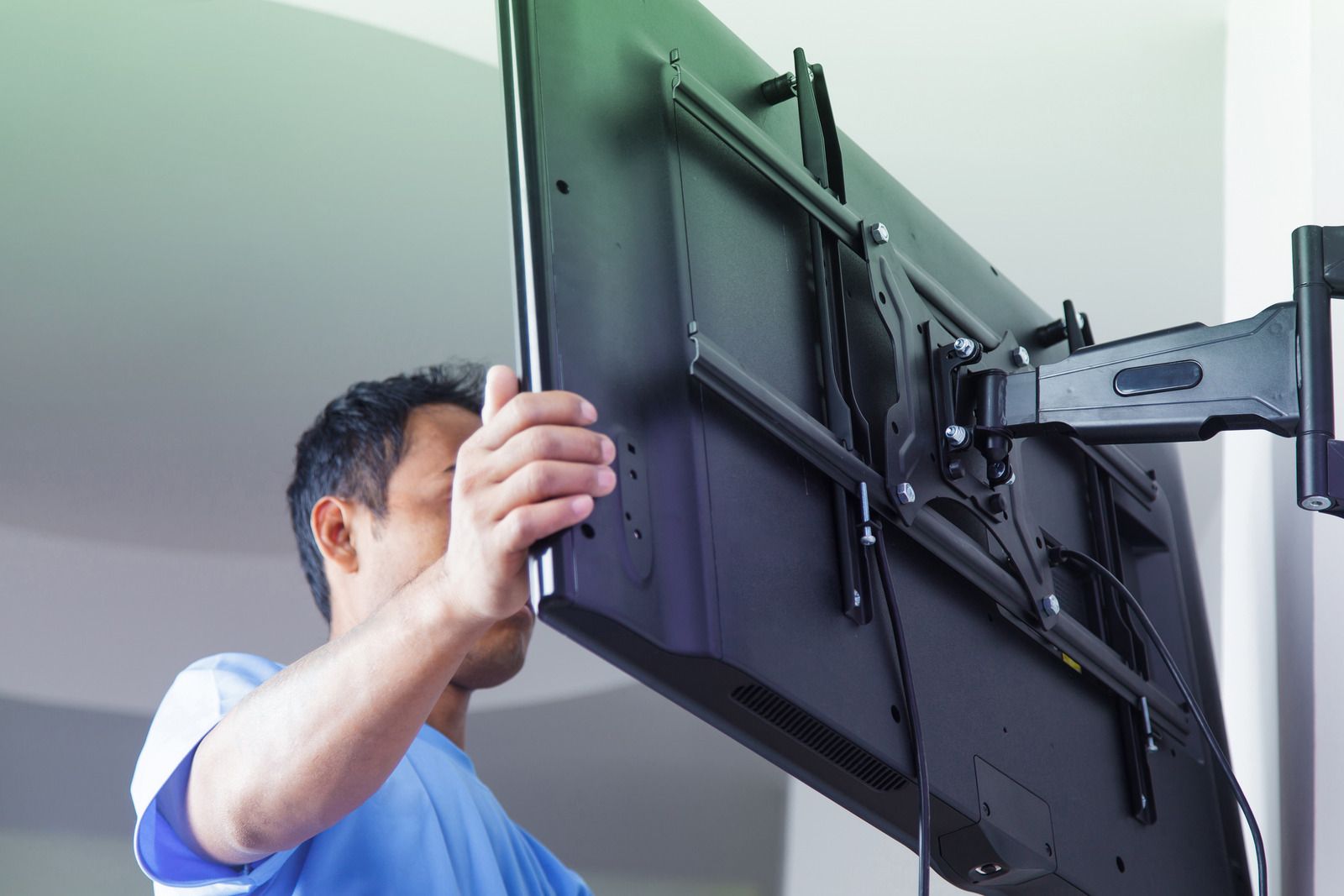
The fix is the mount, not the wall. A tilting mount angles the face downward so the picture aims at seated eyes instead of over their heads. A full-motion arm goes further, pulling the screen out and down when you want it and tucking it back when you don't. In the big two-story great rooms you find all over the Houston suburbs, where the fireplace climbs a tall stone chase, that pull-down travel can be the only thing that makes the spot usable at all. It won't turn a too-high mount into a perfect one, but it drags it back into comfortable range.
TIP: Before you commit to the fireplace wall, sit on your actual couch and have someone hold a piece of cardboard where the center of the screen would land. Ten minutes in that seat tells you more about the viewing angle than any measurement. If your neck aches, plan on a tilting or full-motion mount from the start.
Picking a mount that can handle the spot
Mount choice usually comes down to how much the screen has to move and how much it weighs.
A fixed mount sits flush and looks clean, but it gives you nothing on the angle, which makes it a poor match for most fireplace jobs. A tilting mount adds the downward pitch you almost always need up there. A full-motion mount hands you the most control and the best shot at a comfortable picture, at the cost of a beefier bracket and a more demanding install. Weight and screen size steer the final call, since a big panel on an extended arm pulls hard on the wall.
That wall has to carry it. Never hang a TV over a fireplace without hitting studs or, on masonry, setting proper heavy-duty anchors rated for the load. Skip that and the whole thing is one bump away from the floor. Get the screen size in proportion, too. A TV that reads the same width as the firebox or a touch smaller keeps the wall balanced, while an oversized panel crammed above a narrow hearth looks squeezed and top-heavy.
Wiring behind brick and stone
This is where the fireplace wall earns its reputation as a pain. Running power and HDMI behind drywall is routine. Running them behind brick, natural stone, or manufactured veneer is a different animal, and there's often no open cavity to fish a wire through at all.
Left unsolved, you get a cord dangling down the stone like a shoelace nobody tied, which undoes the whole reason for mounting the TV up there. And a cable run too close to a firebox is its own hazard. The route has to be planned before the mount goes up, because after the screen is on the wall your options shrink to whatever's already there.
Map the whole path first. Where the power comes from, how the HDMI reaches the cable box or the streaming stick, and whether any of it passes near the heat. Some homes around Richmond and Spring were built with a recessed niche and outlets already set above the fireplace, which spares you the worst of this. Most weren't. Either way, the wiring plan comes before the drill, not after.
WARNING: Running cable inside a wall cavity near a firebox or chimney is not a spot to improvise. Heat, clearance, and the type of cable all matter for safety, and a wire tucked too close to the fire is a real risk. Have this part handled by a pro who knows how to route it correctly rather than snaking an extension cord up behind the stone.
Frequently Asked Questions
Is it safe to mount a TV over a fireplace?
Yes, with the right precautions. Heat off the firebox, wall structure, and viewing angle all need checking first. A gas or electric unit with managed heat can run for years. Wood-burning fireplaces with no heat plan cause trouble.
How far above the fireplace should the TV be mounted?
A common range is 8 to 12 inches between mantel top and screen bottom, though it shifts with your fireplace and wall height. The hotter the unit, the more clearance you want, keeping the screen above rising heat.
Can the heat from my fireplace really damage a TV?
It can, usually slowly. Most sets are rated up to 100-104 degrees, and unmanaged fireplace walls can climb past that. Over time this shows as dead pixels, a warped bezel, or shutdowns. Managing heat prevents it.
Do I need a special mount for a TV over a fireplace?
Most of the time, yes. A fixed mount aims the screen over your head. A tilting mount angles down toward viewers; full-motion arms pull out and down. The right choice depends on screen size and wall height.
Can I hide the wires if my fireplace is brick or stone?
It's harder than drywall but doable. Masonry rarely has an open cavity, so the path must be planned before mounting. Options range from in-wall routing to low-profile surface channels. Mapping the route first avoids disruptive retrofits.
Should the TV be bigger or smaller than the fireplace?
As a rule, match the firebox width or go slightly smaller, keeping the wall balanced. Oversized panels over narrow hearths are common now, but proportion makes the wall read as one clean focal point, not competing elements.
Before you pick up the drill
The fireplace wall isn't a bad place for a TV. It's a demanding one, and demanding spots reward planning. Settle the heat, choose a mount that fixes the angle, and map the wiring before the first hole goes in the wall. Do that in order and the screen over your fireplace stops being a gamble and starts being the thing the whole room was built around, working just as well on a July afternoon as on the coldest night of a Houston winter.
Book a
fireplace TV assessment
— you get a mount choice and a heat-and-wiring plan matched to your firebox and wall before anything is drilled. Hangman AV, based in Houston, Texas, brings 18
years of experience handling the framing, in-wall cable routing, and screen setup across the city and its suburbs.